Aztec Calendar Sun Stone: History, Symbols, and Reading Guide
The Aztec Sun Stone, also known as the Piedra del Sol, represents one of the most iconic artifacts of Mesoamerican civilization, embodying the Aztecs’ complex understanding of time, cosmology, and divine order. Carved during the reign of Moctezuma II around 1502-1520, this massive basalt monolith served primarily as a ceremonial altar rather than a functional calendar, symbolizing the cyclical nature of creation and destruction in Aztec mythology. Through its intricate carvings, the stone illustrates the five cosmic eras or “suns,” the 260-day ritual cycle, and the interconnectedness of human sacrifice with cosmic renewal, offering profound insights into Aztec religious and astronomical worldview.
Historical Context and Discovery
The Aztec Sun Stone was created by the Mexica people of Tenochtitlan during the height of the Aztec Empire in the late 15th to early 16th century, specifically under the rule of Moctezuma II, as indicated by inscriptions like “13 Reed” dating to 1503. Weighing approximately 25 tons and measuring about 12 feet in diameter, the monolith was carved from a single block of basalt quarried from distant mountains and transported to the Aztec capital, where it was likely placed in the Templo Mayor’s sacred precinct for ritual use. Spanish chroniclers such as Diego Durán and Juan de Torquemada documented its existence, noting its role in imperial ceremonies, though early accounts vary on its exact placement and function.
Following the Spanish conquest of Tenochtitlan in 1521, the stone was buried face-down in 1524 by order of the Catholic Church under Archbishop Alfonso de Montúfar, who viewed it as a symbol of pagan idolatry and human sacrifice. It remained hidden beneath Mexico City’s main plaza until its rediscovery on December 17, 1790, during urban excavations for civic improvements, where workers unearthed the massive disk near the cathedral. Mexican scholar Antonio de León y Gama conducted the first systematic study in 1792, interpreting it as an astronomical calendar, though modern archaeology emphasizes its ritual significance over practical timekeeping. The stone was publicly displayed on the Mexico City Cathedral’s exterior from 1792 to 1885 before being moved to the National Museum of Anthropology, where it remains a national symbol of Mexican indigenous heritage.
Physical Description and Construction
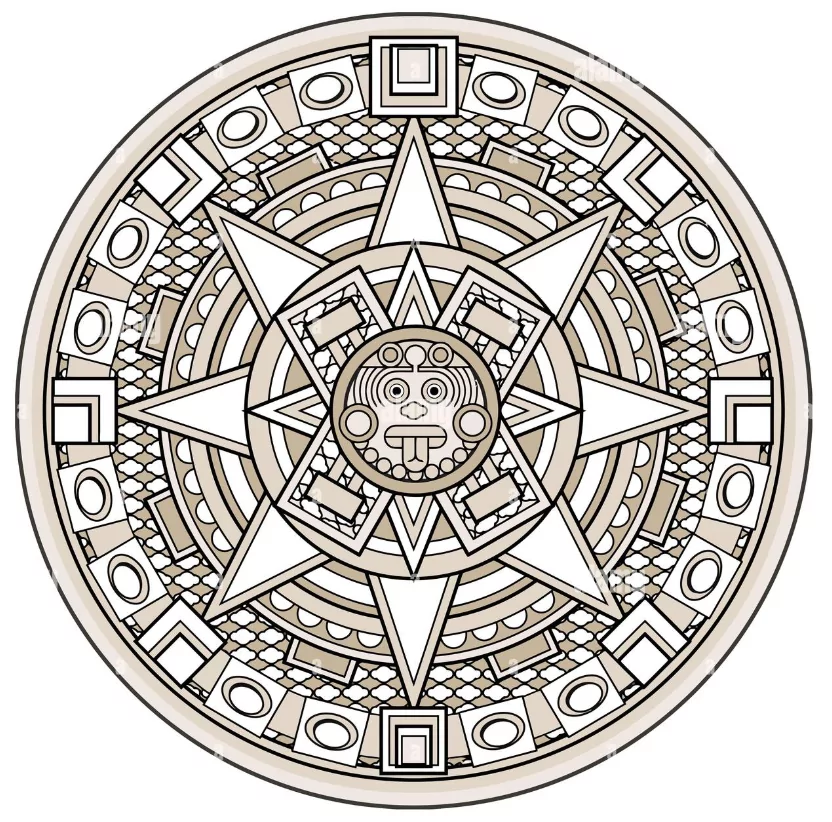
The Sun Stone features a circular design with a diameter of approximately 3.6 meters (11.8 feet) and a thickness of 0.98 meters (3.2 feet), carved in low relief with precise glyphs covering its surface in five concentric rings. Its irregular edges suggest it may be unfinished or damaged during transport, and the central face protrudes dramatically, representing the sun god Tonatiuh with claw-like hands grasping human hearts. The artwork employs a sophisticated iconography blending astronomical, mythological, and historical elements, executed with exceptional craftsmanship that reflects the Aztecs’ mastery of stoneworking without metal tools.
Archaeological analysis reveals the stone’s creation involved hundreds of artisans using obsidian and other hard stones for carving, with the basalt sourced from the Sierra de las Navajas region over 200 kilometers away. Inscriptions such as the ruler’s turquoise diadem glyph and dates like “One Flint,” “One Rain,” and “Seven Monkey” tie the monument to Moctezuma II’s reign and specific historical events, including his 1503 coronation. While not a working calendar, its layout references the Aztec xiuhpohualli (solar year of 365 days) and tonalpohualli (260-day ritual cycle), underscoring the culture’s dual-calendar system for divination and agriculture .

Symbolic Elements and Cosmological Meaning
Central Face: Tonatiuh, the Fifth Sun
The monumental central disk depicts Tonatiuh, the sun god of the current era, with a snarling face featuring large ear spools, fangs, and a protruding flint knife tongue symbolizing sacrificial bloodletting to sustain the sun’s movement. His clawed hands grasp human hearts, emphasizing the Aztec belief that blood sacrifice was essential to prevent cosmic catastrophe and ensure the sun’s daily journey across the sky. This central motif represents the Fifth Sun, or Nahui Ollin (Movement), destined to end in earthquakes, contrasting with the four previous destroyed worlds.
Inner Rings: The Four Previous Suns
Surrounding Tonatiuh are two inner rings detailing the destruction of prior cosmic ages: the first ring shows the glyphs for the four previous suns—Jaguar (Tezcatlipoca’s era ending in jaguar devouring), Wind (Quetzalcoatl’s era with hurricanes), Rain (Tlaloc’s era of fire rain), and Water (Chalchiuhtlicue’s era of flood)—each with symbolic monsters representing their apocalyptic ends. The second ring elaborates on the Fifth Sun’s movement symbol (Ollin), incorporating date glyphs like 4 Olin (Movement), the predicted doomsday every 260 days when sacrifices renewed the world. These elements convey the cyclical view of time where creation follows destruction, with human sacrifice mirroring divine acts to maintain universal balance [web:1][image:12].
Day Signs and Xiuhmolpilli Ring
The third ring contains the 20 day glyphs of the tonalpohualli ritual calendar, read counterclockwise from Cipactli (Crocodile) to Xochitl (Flower), representing the sacred 260-day cycle used for divination and naming children. Interspersed are five nemontemi (unlucky days) at year ends, and the ring’s flames and serpents symbolize solar energy and Xiuhcoatl, the fire serpent aiding the sun. This layer connects daily life to cosmic forces, where each day-sign carried omens influencing agriculture, warfare, and rituals .
Outer Rings: Cosmic and Geographic Markers
The outermost ring features two fire serpents (Xiuhcoatl) facing each other, their bodies forming starry skies with flint knives and dots, while their heads frame the stone’s edges as if devouring the world. Four cardinal direction pointers extend outward, possibly representing the earth’s corners or the five cosmic levels, with the serpents embodying the sun’s rebirth. Additional elements include the date 13 Reed (1479 or 1507) and astronomical markers tying the stone to the 52-year Calendar Round cycle, where the New Fire Ceremony renewed the world to avert the Fifth Sun’s end.
Reading and Interpreting the Sun Stone
To read the Sun Stone, begin at the center with Tonatiuh’s face, symbolizing the current Fifth Sun’s precarious existence sustained by sacrifice, then move outward counterclockwise through the rings: inner rings detail past destructions and the Ollin symbol’s earthquake prophecy; the day-sign ring follows the tonalpohualli sequence for ritual timing; and outer serpents represent solar renewal and cosmic boundaries. Key dates like 4 Olin mark apocalyptic cycles every 260 days, when sacrifices on the stone ensured continuity, while geographic pointers align with Aztec cosmology’s four quadrants. Interpretation requires understanding the dual calendars: the solar xiuhpohualli for agriculture and the divinatory tonalpohualli for fate, with the stone serving as a visual mnemonic rather than a computational tool .
Modern readings emphasize its role in state ideology, legitimizing Moctezuma II’s rule by linking imperial power to cosmic order, with sacrifices on the stone reinforcing social hierarchy and military prowess. While early scholars like León y Gama saw it as a sundial or astrological device, contemporary experts view it as a ritual altar for gladiatorial sacrifices and New Fire ceremonies, where victims’ hearts fed Tonatiuh to prevent the world’s end. The counterclockwise flow mirrors the sun’s path, and symbols like the diadem glyph personalize it to Mexica history.
Cultural and Modern Significance
Beyond its ritual function, the Sun Stone encapsulated Aztec philosophy of impermanence, where time’s cycles demanded active human participation through sacrifice to avert destruction, influencing art, architecture, and governance. Post-conquest burial symbolized cultural erasure, but its 1790 rediscovery sparked Mexican nationalism, becoming a emblem of pre-Columbian heritage on currency, stamps, and public art. Today, it inspires studies in Mesoamerican astronomy, with its precise glyphs revealing advanced knowledge of solar and ritual calendars, and serves as a reminder of the empire’s sophistication before Spanish colonization.
Recent interpretations highlight its ominous tone, foreseeing the Fifth Sun’s earthquake end, yet affirming renewal through ritual, contrasting with modern linear time views. Exhibited at the National Museum of Anthropology since 1964, replicas worldwide educate on Aztec cosmology, while ongoing excavations at Templo Mayor uncover related artifacts, deepening understanding of its ceremonial context .
Conclusion
The Aztec Sun Stone masterfully intertwines history, mythology, and astronomy in a monumental testament to Mexica worldview, where time’s relentless cycles demanded sacrifice for cosmic survival. From its creation under Moctezuma II to its rediscovery and modern reverence, the artifact transcends its physical form to symbolize indigenous resilience and intellectual depth. By decoding its layered symbols—from Tonatiuh’s fierce visage to the encircling day glyphs—scholars and enthusiasts alike uncover the Aztecs’ profound engagement with the universe, offering timeless lessons on humanity’s role in maintaining existential balance.

